
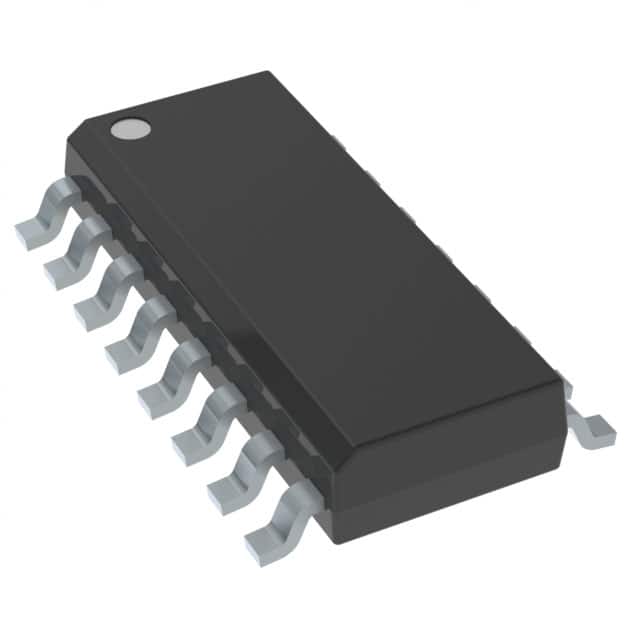


Overview
The SN74LS595NSR, manufactured by Texas Instruments, is an 8-bit serial-in, parallel-out shift register with output latches. This component is widely used in digital electronics for applications requiring data storage and transfer. It is particularly valued for its ability to expand the number of output pins on microcontrollers, making it a popular choice in LED displays, digital clocks, and other control systems. The SN74LS595NSR is part of the LS series, known for its low power consumption and compatibility with TTL logic levels.
Key Specifications
| Parameter | Value | Unit | Notes |
|---|---|---|---|
| Logic Type | Shift Register | - | 8-bit |
| Supply Voltage | 4.75 to 5.25 | V | TTL compatible |
| Operating Temperature | 0 to 70 | °C | - |
| Output Current | ±6 | mA | High-level output |
| Package | SOIC-16 | - | Surface Mount |
Key Features
- 8-bit serial input/output shift register.
- Separate clocks for shift register and storage register.
- Three-state output buffers for bus interface applications.
- Direct clear function for the shift register.
- High-speed operation with typical shift frequency of 35 MHz.
Applications
The SN74LS595NSR is extensively used in various digital systems for serial to parallel data conversion. Common applications include LED matrix displays, where it drives multiple LEDs with minimal microcontroller pins. It is also employed in digital clocks, control panels, and data acquisition systems, providing efficient data handling and output expansion capabilities. Its three-state outputs make it suitable for bus-oriented systems.
Q & A
What is the primary function of the SN74LS595NSR?
The primary function is to convert serial input data into parallel output data, expanding the output capabilities of a microcontroller.
Can the SN74LS595NSR be used with other shift registers?
Yes, it can be cascaded with other shift registers to expand the number of output pins further.
What is the significance of the three-state outputs?
Three-state outputs allow the outputs to be in a high-impedance state, which is useful for bus-connected systems to prevent data conflicts.
How does the direct clear function work?
The direct clear function resets the shift register to a default state, clearing all stored data when activated.
What is the maximum shift frequency of the SN74LS595NSR?
The maximum shift frequency is typically 35 MHz, allowing for high-speed data transfer.
Is the SN74LS595NSR compatible with 3.3V logic?
No, it is designed for 5V TTL logic levels and may not be directly compatible with 3.3V systems without level shifting.
What are the typical applications of this component?
Typical applications include LED displays, digital clocks, and control panels where output expansion is needed.
How does the separate clock for the storage register benefit the design?
It allows for independent control of data shifting and output latching, providing flexibility in timing and data handling.
What is the package type of the SN74LS595NSR?
It comes in an SOIC-16 package, suitable for surface mount technology.
Can the SN74LS595NSR drive high-current loads?
While it can drive moderate loads, for high-current applications, additional drivers or buffers may be required.


