
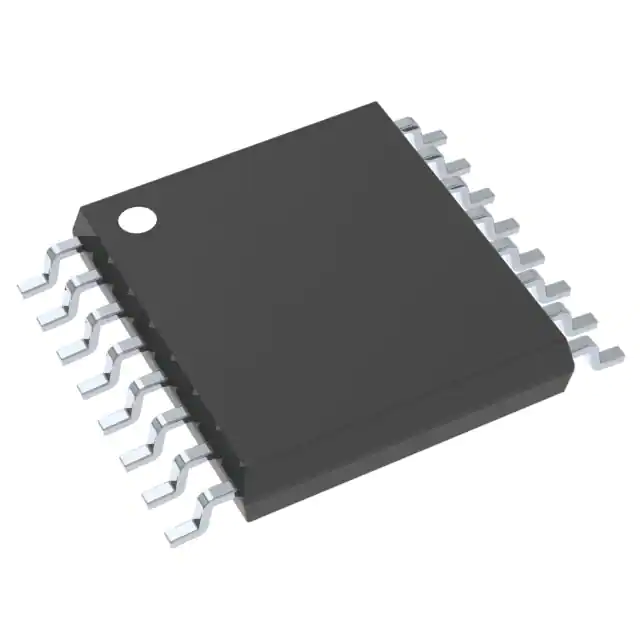


Overview
The CD74HC4094PWR is a high-speed CMOS logic 8-stage serial shift register produced by Texas Instruments. This device features a storage latch associated with each stage, allowing for the transfer of data from the serial input to parallel buffered tri-state outputs. The parallel outputs can be connected directly to common bus lines, making it versatile for various digital circuit applications. Data is shifted on positive clock transitions, and the data in each shift register stage is transferred to the storage register when the Strobe input is high. The Output-Enable signal controls the appearance of data at the outputs.
Key Specifications
| Parameter | Unit | Min | Typ | Max |
|---|---|---|---|---|
| VCC (Supply Voltage) | V | 2 | - | 6 |
| VIH (High-level input voltage) | V | 2 | - | 5.5 |
| VIL (Low-level input voltage) | V | 0.8 | - | - |
| VOH (High-level output voltage) - CMOS loads | V | 4.4 | - | 4.5 |
| VOH (High-level output voltage) - TTL loads | V | 3.7 | - | 4.5 |
| VOL (Low-level output voltage) - CMOS loads | V | 0.1 | - | - |
| VOL (Low-level output voltage) - TTL loads | V | 0.26 | - | - |
| ICC (Supply Current) | µA | 8 | - | 160 |
| ƒCL (MAX) (Maximum CP frequency) | MHz | 20 | - | 30 |
| tPLH, tPHL (Propagation delay time) | ns | 16 | - | 39 |
| tTLH, tTHL (Output transition time) | ns | 13 | - | 22 |
| CIN (Input capacitance) | pF | 10 | - | - |
| CO (Tri-state output capacitance) | pF | 15 | - | - |
Key Features
- Buffered inputs
- Separate serial outputs synchronous to both positive and negative clock edges for cascading
- Fanout: Standard outputs support 10 LSTTL loads, bus driver outputs support 15 LSTTL loads
- Wide operating temperature range: −55°C to 125°C
- Balanced propagation delay and transition times
- Significant power reduction compared to LSTTL logic ICs
- HC types: 2- to 6-V operation, high noise immunity (NIL = 30%, NIH = 30% of VCC at VCC = 5 V)
- HCT types: 4.5- to 5.5-V operation, direct LSTTL input logic compatibility
Applications
- Digital circuit design where serial-to-parallel data conversion is required
- Cascaded shift register applications for extended data storage and transfer
- Bus-oriented systems where tri-state outputs are necessary
- High-speed digital systems requiring low power consumption and high noise immunity
- Industrial and automotive applications due to the wide operating temperature range
Q & A
- What is the primary function of the CD74HC4094PWR?
The primary function is to act as an 8-stage serial shift register with a storage latch for each stage, allowing data to be transferred from serial input to parallel buffered tri-state outputs.
- What are the operating voltage ranges for the HC and HCT types of this device?
The HC type operates from 2 to 6 V, while the HCT type operates from 4.5 to 5.5 V.
- How does the device handle data transfer during clock transitions?
Data is shifted on positive clock transitions, and the data in each shift register stage is transferred to the storage register when the Strobe input is high.
- What are the fanout capabilities of the CD74HC4094PWR?
Standard outputs support 10 LSTTL loads, and bus driver outputs support 15 LSTTL loads.
- What is the maximum clock frequency for this device?
The maximum clock frequency (ƒCL) is up to 30 MHz.
- How does the device handle output enable and disable times?
The output enable and disable times (tPZH, tPZL) are typically around 35 ns.
- What is the input capacitance of the CD74HC4094PWR?
The input capacitance (CIN) is 10 pF.
- Can the CD74HC4094PWR be used in high-temperature environments?
Yes, it operates over a wide temperature range from −55°C to 125°C.
- How does the device reduce power consumption compared to LSTTL logic ICs?
The device significantly reduces power consumption compared to LSTTL logic ICs due to its CMOS technology.
- What are the typical propagation delay times for this device?
The propagation delay times (tPLH, tPHL) range from 16 to 39 ns.


