
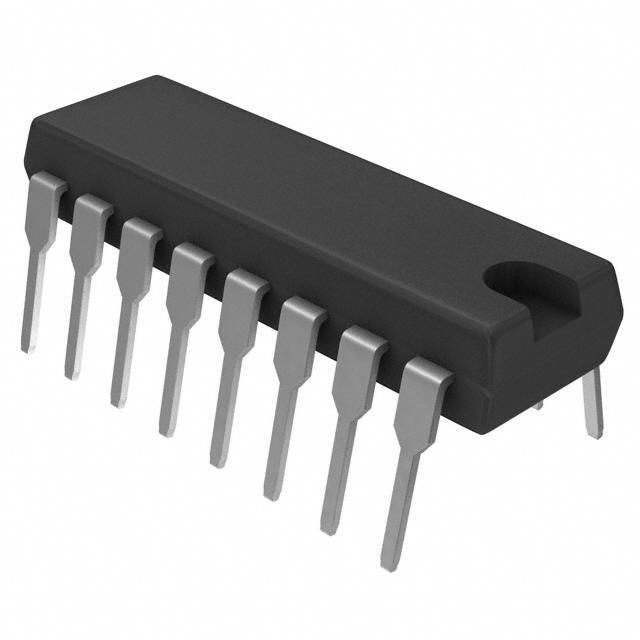


Overview
The CD4021BE is an 8-bit static shift register IC manufactured by Texas Instruments. It is designed for parallel-to-serial data conversion and is widely used in digital electronics applications. This component features medium-speed operation, fully static operation, and is known for its simplicity and reliability in digital systems. The CD4021BE allows for both parallel and serial data entry, controlled by the PARALLEL/SERIAL CONTROL input, making it versatile for various serial data handling tasks.
Key Specifications
| Specification | Value |
|---|---|
| Supply Voltage Range | 3V to 18V |
| Number of Bits | 8 |
| Operating Temperature Range | -55°C to +125°C |
| Output Current | 6mA |
| Propagation Delay | 140ns |
| Package Type | 16-pin DIP, SOIC, and other variants |
| Clock Rate | 12 MHz (typ.) at VDD - VSS = 10 V |
| Noise Margin | 1 V at VDD = 5 V, 2 V at VDD = 10 V, 2.5 V at VDD = 15 V |
| Input Current | 1 µA at 18 V over full package-temperature range; 100 nA at 18 V and 25°C |
Key Features
- Simple Parallel-to-Serial Conversion: Converts parallel input data to a serial output stream.
- Wide Supply Voltage Range: Operates from 3V to 18V, making it versatile for different voltage systems.
- Low Power Consumption: Consumes minimal power during operation.
- High-Speed Operation: Provides fast data processing with low propagation delay.
- Cascadable: Multiple CD4021BE ICs can be cascaded for extended data handling capabilities.
- Fully Static Operation: Ensures stable operation without the need for a clock signal to maintain the state.
- Standardized Symmetrical Output Characteristics: Ensures consistent output behavior across different operating conditions.
- Meets JEDEC Standards: Complies with JEDEC Tentative Standard No. 13B for 'B' Series CMOS Devices.
Applications
- Parallel Input/Serial Output Data Queuing: Ideal for applications requiring the conversion of parallel data to serial format.
- Parallel to Serial Data Conversion: Used in systems where data needs to be converted from parallel to serial format efficiently.
- General-Purpose Register: Can be used as a general-purpose register in various digital systems.
- Digital Displays: Utilized in digital display systems for data processing and control.
- Data Acquisition Systems: Employed in data acquisition systems for serial data handling.
- Control Systems and Industrial Automation: Used in control systems and industrial automation for efficient data processing and control operations.
Q & A
- What is the primary function of the CD4021BE IC?
The primary function of the CD4021BE IC is to perform parallel-to-serial data conversion. - What is the supply voltage range for the CD4021BE?
The CD4021BE operates within a supply voltage range of 3V to 18V. - How many bits does the CD4021BE shift register handle?
The CD4021BE handles 8 bits of data. - What is the typical clock rate for the CD4021BE?
The typical clock rate for the CD4021BE is 12 MHz at VDD - VSS = 10 V. - Can the CD4021BE be cascaded with other ICs?
Yes, multiple CD4021BE ICs can be cascaded for extended data handling capabilities. - What are the common applications of the CD4021BE?
The CD4021BE is commonly used in digital displays, data acquisition systems, serial input devices, control systems, and industrial automation. - How does the CD4021BE compare to the 74HC595?
The CD4021BE offers parallel-to-serial conversion with a wider supply voltage range, while the 74HC595 features serial-in-parallel-out functionality with a lower supply voltage requirement and faster shift clock speed. - What are the advantages of using the CD4021BE?
The advantages include simple parallel-to-serial conversion, wide supply voltage range, low power consumption, high-speed operation, and cascading capabilities. - What are the disadvantages of using the CD4021BE?
The disadvantages include being limited to 8-bit parallel-to-serial conversion and potentially requiring an external clock signal for operation. - What is the package type for the CD4021BE?
The CD4021BE is available in 16-pin DIP, SOIC, and other package variants.


