
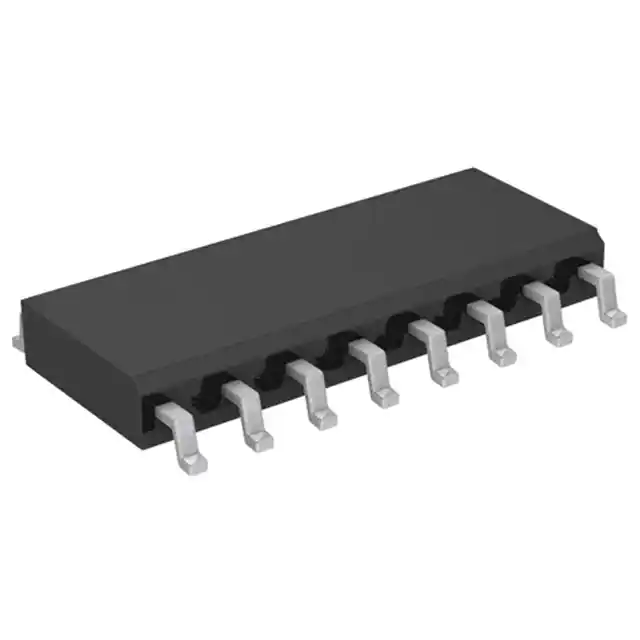


Overview
The 74HC166D/AU118 is an 8-bit parallel-in/serial-out shift register produced by NXP USA Inc. This device is part of the 74HC family, known for its CMOS low power dissipation and high noise immunity. It features a versatile design that allows for both parallel and serial data input, making it suitable for a wide range of digital logic applications.
Key Specifications
| Type Number | VCC (V) | Logic Switching Levels | Output Drive Capability (mA) | tpd (ns) | fmax (MHz) | Number of Bits | Power Dissipation Considerations | Tamb (°C) | Rth(j-a) (K/W) | Ψth(j-top) (K/W) | Rth(j-c) (K/W) | Package Name |
|---|---|---|---|---|---|---|---|---|---|---|---|---|
| 74HC166D | 2.0 - 6.0 | CMOS | ± 5.2 | 15 | 63 | 8 | Low | -40 to +125 | 74 | 1.2 | 32 | SO16 |
Key Features
- Parallel and Serial Input/Output: The device can load data in parallel from eight inputs (D0 to D7) and shift it out serially through one output (Q7), or load data serially through one input (DS).
- Clock and Enable Inputs: Features clock input (CP), parallel enable input (PE), and clock enable input (CE) for flexible control over data shifting and loading.
- Wide Supply Voltage Range: Operates from 2.0 V to 6.0 V, making it versatile for various applications.
- Low Power Dissipation: CMOS technology ensures low power consumption.
- High Noise Immunity: Provides robust performance against noise.
- Latch-Up Performance: Exceeds 100 mA per JESD 78 Class II Level B.
- ESD Protection: Complies with JEDEC standards for HBM (ANSI/ESDA/JEDEC JS-001 class 2 exceeds 2000 V) and CDM (ANSI/ESDA/JEDEC JS-002 class C3 exceeds 1000 V).
Applications
- Synchronous Parallel-to-Serial Applications: Ideal for converting parallel data to serial data in synchronous systems.
- I/O Expansion: Useful in expanding input/output capabilities in digital systems.
- Digital Logic Circuits: Can be used in various digital logic circuits requiring data shifting and conversion between parallel and serial formats.
Q & A
- What is the primary function of the 74HC166D/AU118?
The primary function is to act as an 8-bit parallel-in/serial-out shift register, allowing data to be loaded in parallel and shifted out serially or loaded serially and shifted out serially.
- What is the supply voltage range for the 74HC166D/AU118?
The device operates from 2.0 V to 6.0 V).
- What are the logic switching levels for the 74HC166D/AU118?
The logic switching levels are CMOS for the 74HC166D).
- What is the maximum clock frequency for the 74HC166D/AU118?
The maximum clock frequency is 63 MHz).
- What is the package type for the 74HC166D/AU118?
The package type is SO16 (SOT109-1)).
- Does the 74HC166D/AU118 have ESD protection?
Yes, it complies with JEDEC standards for HBM and CDM).
- What is the operating temperature range for the 74HC166D/AU118?
The operating temperature range is from -40 °C to +125 °C).
- Can the 74HC166D/AU118 be used in synchronous parallel-to-serial applications?
Yes, it is suitable for synchronous parallel-to-serial applications).
- How does the clock enable input (CE) affect the device?
A HIGH on CE disables the clock input (CP), preventing data from being shifted).
- What is the significance of the parallel enable input (PE) in the 74HC166D/AU118?
The parallel enable input (PE) controls whether data is loaded in parallel or serially. When PE is LOW, data is loaded in parallel; when PE is HIGH, data is loaded serially).


